Bitcoin (BTC)

How to Buy Bitcoin (BTC) on LBank

Learn how to buy Bitcoin (BTC) on LBank, including payment methods such as credit cards, debit cards, Apple Pay, and bank transfers, as well as the purchase process, preparations, and FAQs.

Step 1
Download the LBank App
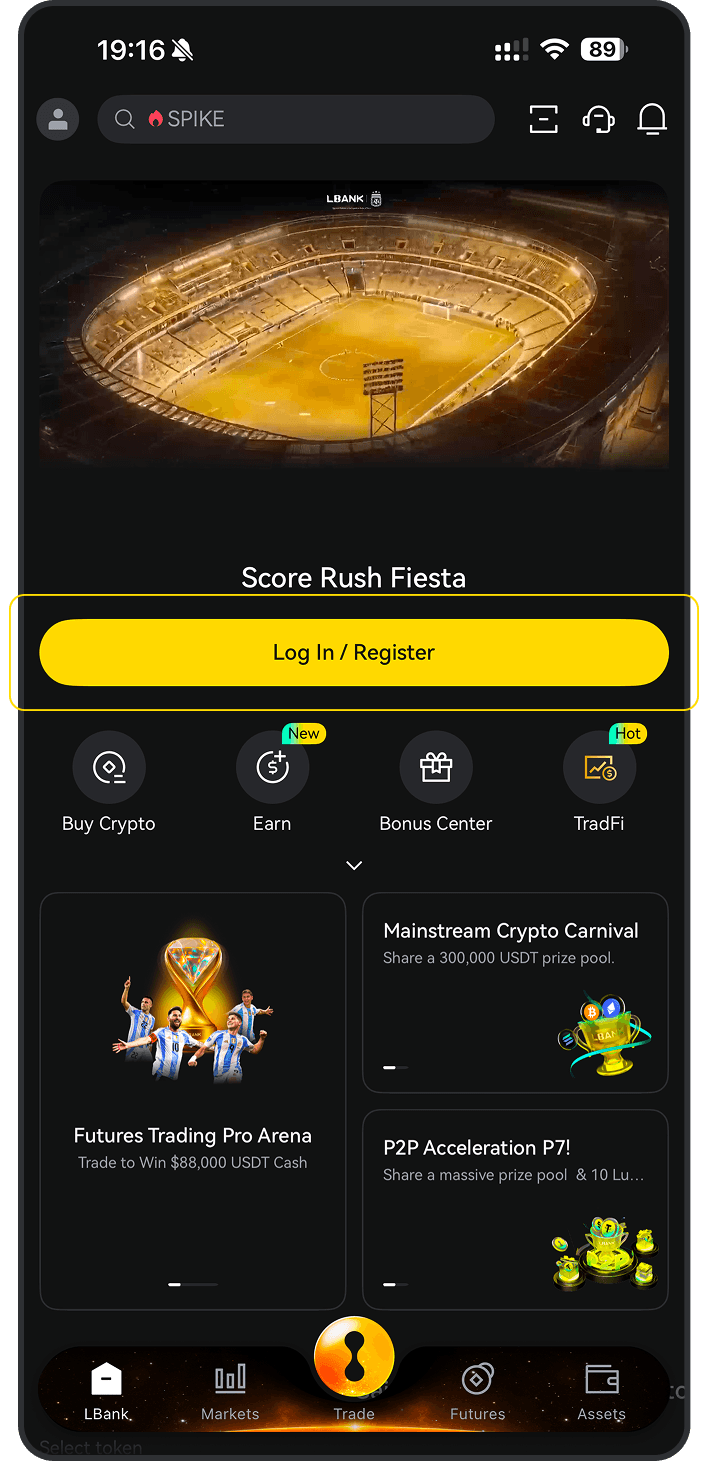
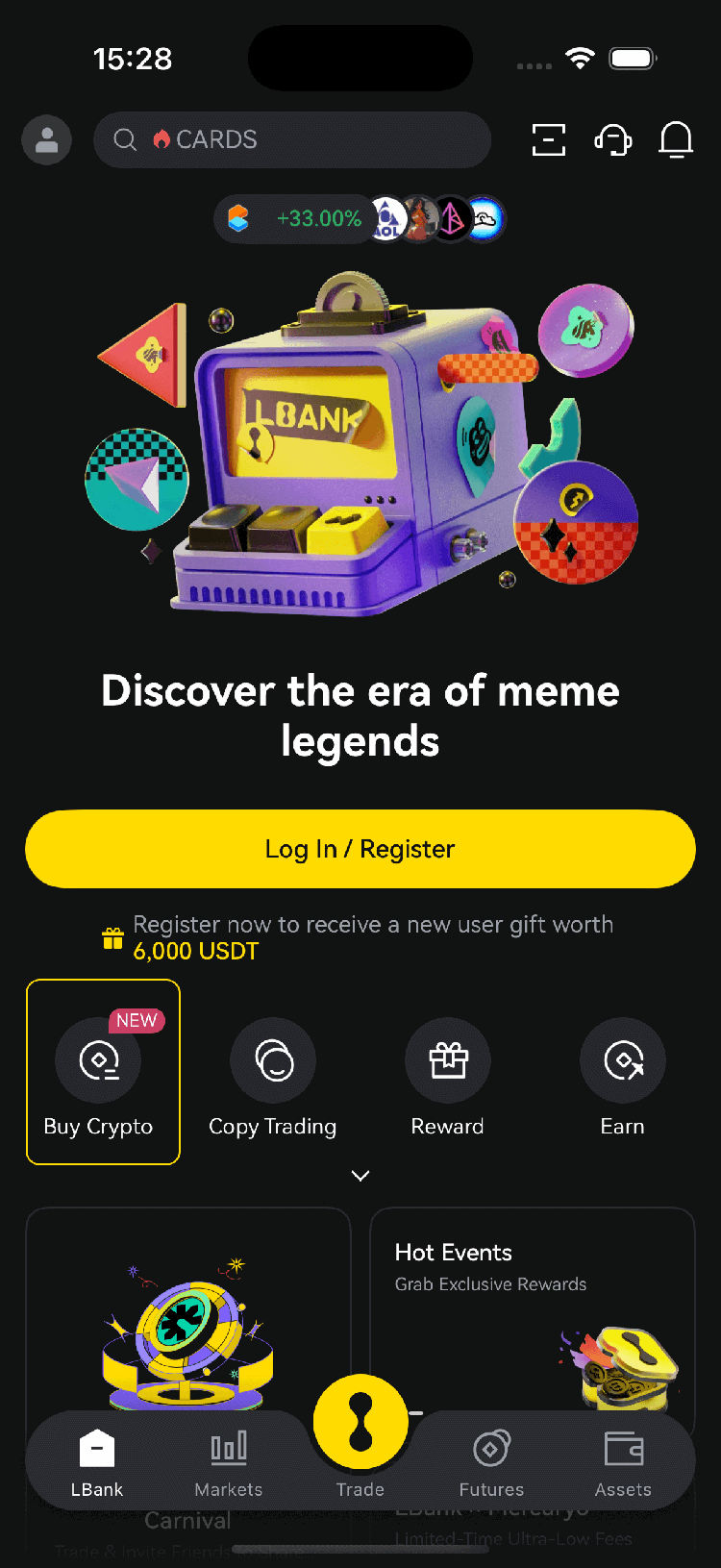
Please download the LBank App and register to get started
Step 2
Fund your account
Deposit using your preferred payment method.
Step 3
Choose your cryptocurrency
Select the crypto you want to buy from over 3,000,000 cryptocurrencies available on LBank Exchange or Wallet.

Purchase Decision Overview

Credit / Debit Card

Credit / Debit Card

Fee
Variable Fees
Processing Time
Usually within 1 minute, up to 48 hours
Minimum Purchase Amount
Starting from approx. 10–15 USD
Supported Regions
Subject to region, fiat currency, issuing bank, and payment channel support
Bank Transfer / Local Transfer

Bank Transfer / Local Transfer

Fee
Variable Fees
Processing Time
Depends on the payment method; some local channels may be faster
Minimum Purchase Amount
Starting from approx. 1–10 USD
Supported Regions
Subject to local payment channel support

Three Simple Steps to Buy BTC on LBank

Register an LBank account

How to Buy BTC on LBank: Payment Methods Overview

Explore the available payment methods for buying BTC on LBank, including credit card, debit card, bank transfer, Apple Pay, Google Pay, PayPal, and P2P, to quickly choose the most suitable way to buy BTC.

Credit / Debit Card
Credit / Debit Card
Processing Time: Usually within 1 minute; up to 48 hours
Use a Visa/Mastercard that supports international online transactions and ensure 3D Secure is enabled; if it fails, try a different card or try again later
Common Reasons for Failure: The issuing bank declined the cryptocurrency transaction; insufficient balance; 3D Secure verification failed; risk control interception; or region/card network not supported
Bank Transfer / Local Transfer
Processing Time: Instant or 1–3 Business Days
Verify the receiving account, reference code, and transfer network, and use a bank account consistent with your identity verification
Common Reasons for Failure: Incorrect receiving information or reference code; name mismatch; bank processing delay; or unsupported transfer network

What Do You Need to Prepare Before Buying Bitcoin (BTC) on LBank?

Check the preparations required before buying Bitcoin (BTC) on LBank, including account registration, identity verification (KYC), payment methods, regional availability, and pre-purchase precautions to help you smoothly complete the BTC purchase process.

Suitable for
Users who want to quickly buy BTC with fiat
Before You Buy: Checklist
Register and log in to your account
Complete required KYC
Prepare payment method
Confirm regional availability,Check limits / fees / processing time
User Path
Buy Crypto

How to Buy Bitcoin on LBank – Step-by-Step Guide

Before you begin, decide how you’d like to pay:

Pay with fiat

If you're new to crypto, using fiat currency (such as USD, EUR, etc.) is the easiest way to buy Bitcoin. LBank supports various payment methods, including debit cards, credit cards, bank transfers, and other local payment options where available. You may need to fund your LBank account before making a purchase.

Pay with other cryptocurrencies

If you already hold other cryptocurrencies, you can trade them for Bitcoin on LBank. Please make sure that LBank supports the trading pair you need (e.g., Bitcoin (BTC)). LBank offers a wide range of trading pairs, allowing you to conveniently convert your existing crypto into Bitcoin.

LBank supports multiple payment methods

You can use the following payment methods to purchase Bitcoin on LBank:

Debit card
Credit / Debit Card
PayPal
Apple Pay
Google Pay

Mobile app guide

1
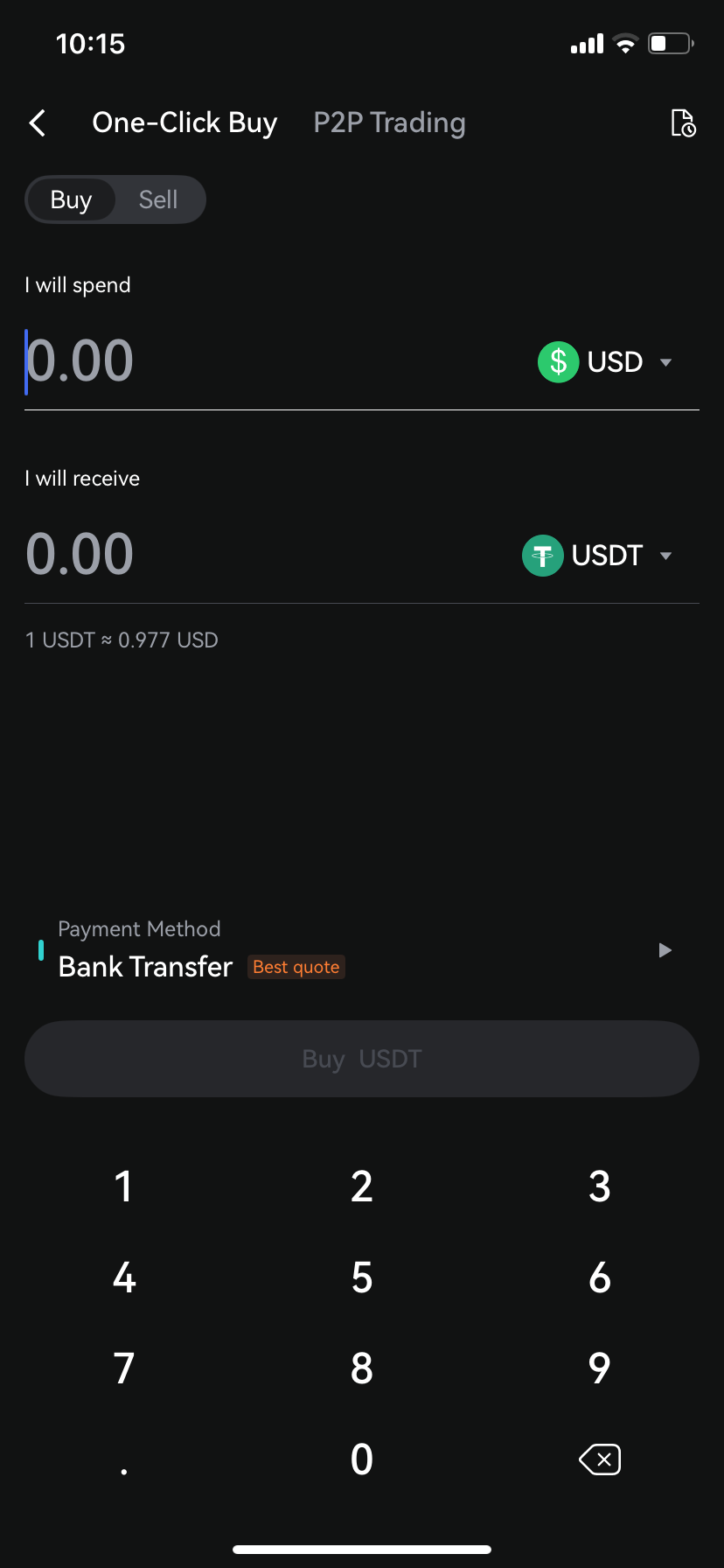
Open the LBank mobile app and tap “Buy Crypto”
2
Select “Buy”
3
Choose , enter the fiat currency you want to use, input the amount, then tap “Buy” or “Confirm”

Desktop guide

1
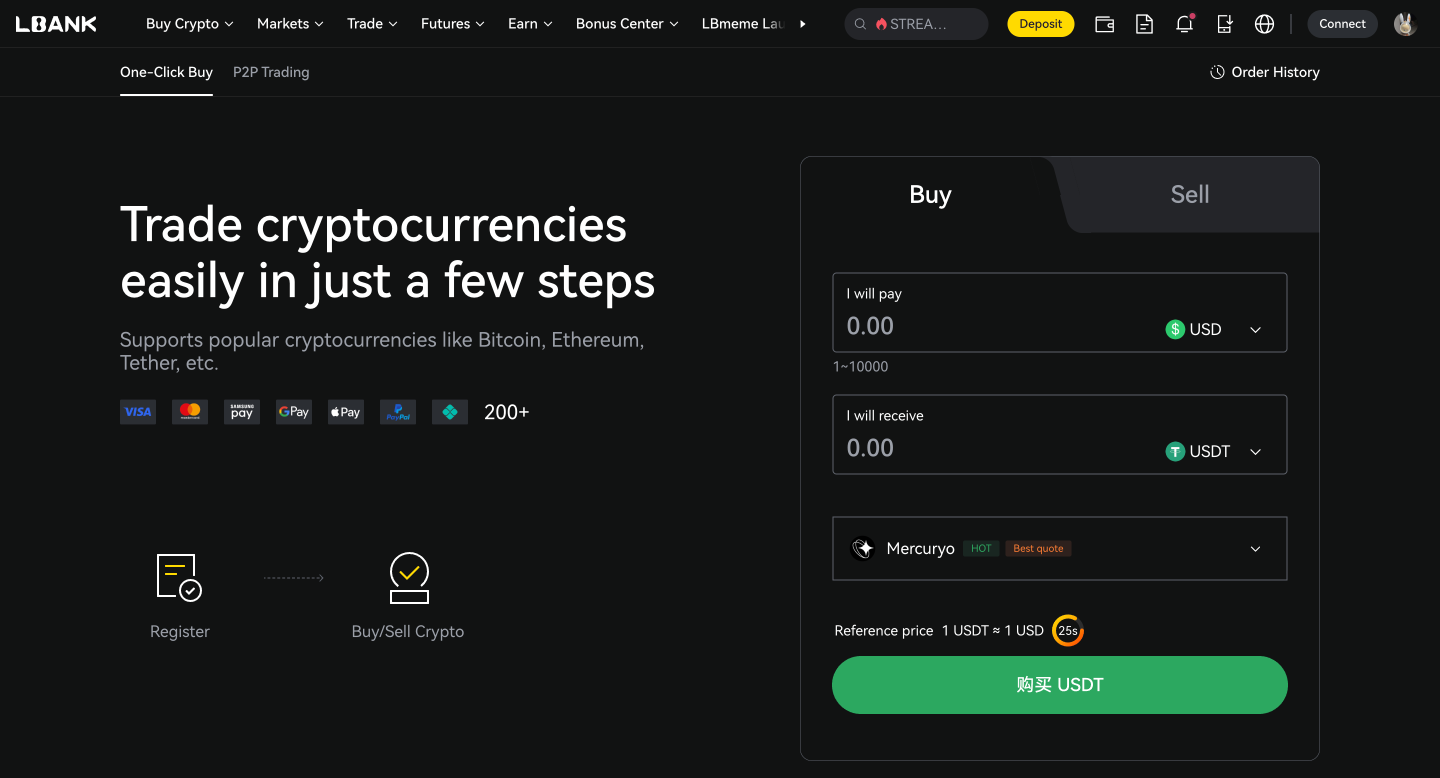
Log in to LBank on your desktop browser and click the “One-Click Buy” option.
2
Under the “One-Click Buy” tab:

(a). Choose the fiat currency you want to use

(b). Select the Bitcoin you want to purchase

(c). Enter an amount or use quick-select options (e.g., 100, 200, 500, max)
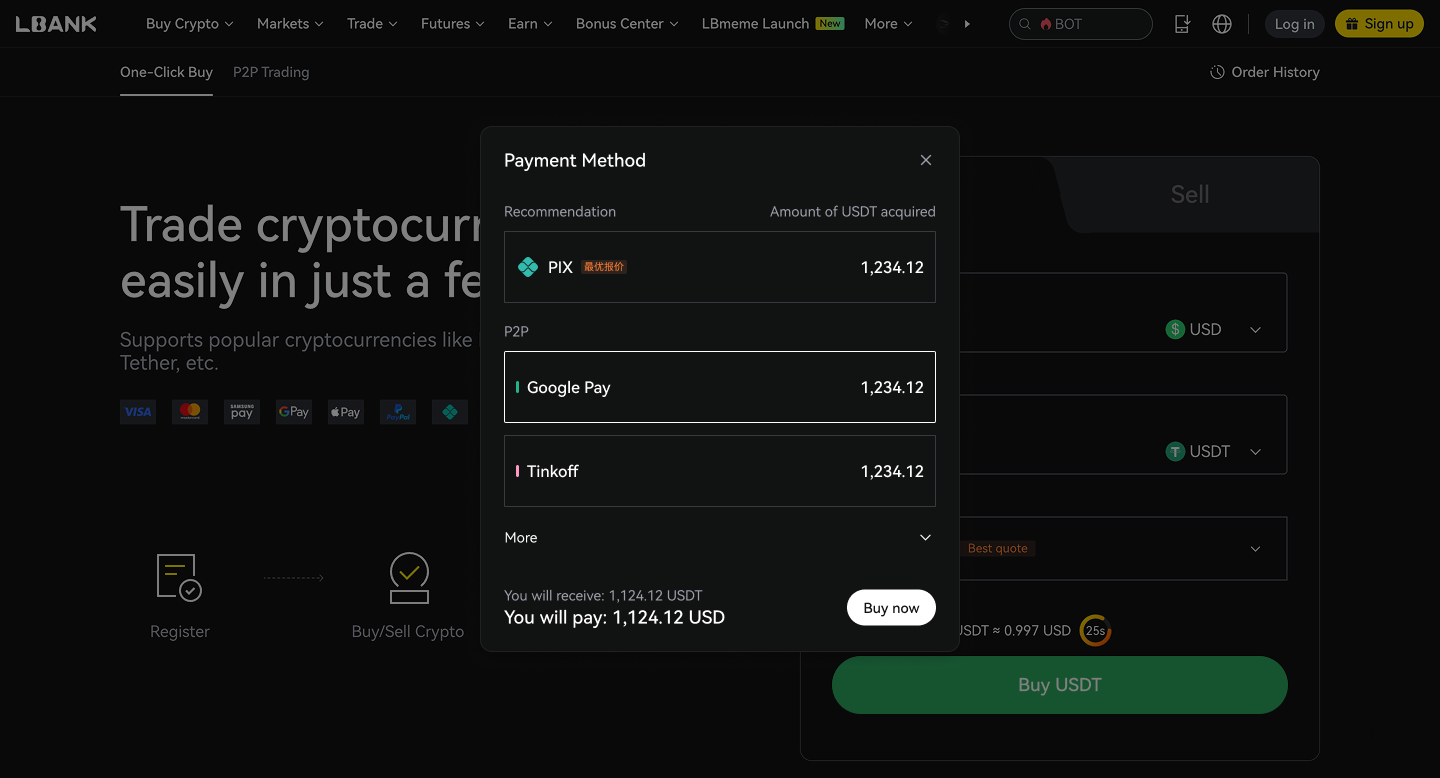
(d). Choose your payment method
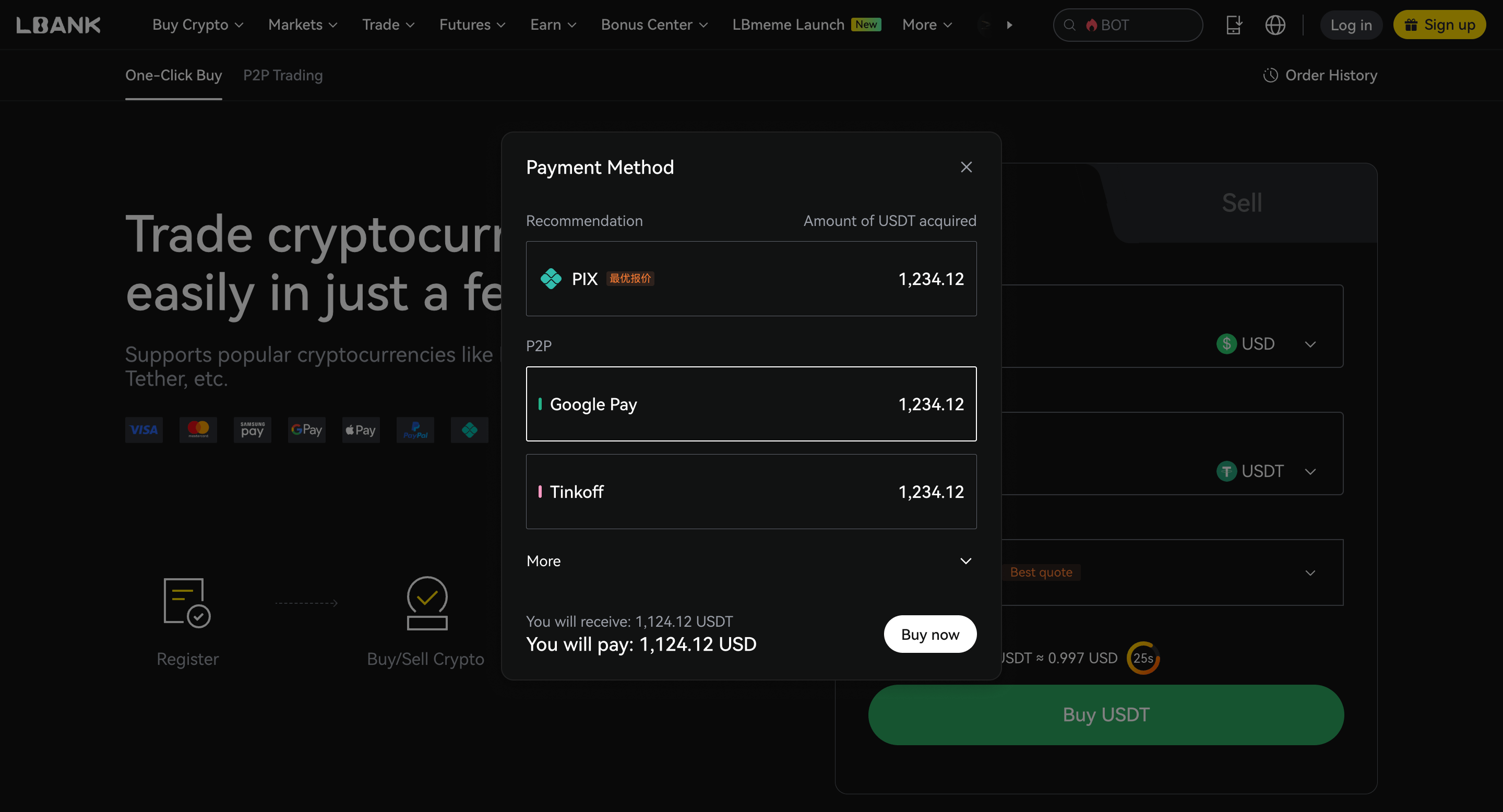
(e). Click “Confirm” or “Buy now”
P2P Trading

Merchant
Price
Amount | Limit
Payment Method
Action
LO
Loyalty_Trader
1080 min | 100%
0.918 USD
6993.53 USDT
500.000 - 6420.060USD
Bank Transfer
MY
MYR_ DUITNOW _MYR
733 min | 100%
1.000 USD
1098.06 USDT
50.000 - 1098.060USD
Bank Transfer
IC
ice trader fast
397 min | 100%
1.000 USD
241.94 USDT
5.000 - 241.940USD
Bank Transfer

What is Bitcoin (BTC)?

Bitcoin is a decentralized digital currency and the first application of blockchain technology. It was introduced in 2008 through a whitepaper titled Bitcoin: A Peer-to-Peer Electronic Cash System, authored by a pseudonym known as Satoshi Nakamoto. The network officially went live in January 2009, marking the birth of the first functional cryptocurrency. The fundamental goal of Bitcoin is to facilitate peer-to-peer electronic payments without the involvement of central authorities, such as banks or government institutions. It operates as a decentralized network where transactions are verified by a global community of participants rather than a single entity. The underlying technology, the blockchain, serves as a public ledger that records every transaction ever made on the network. This ledger is distributed across thousands of computers, or nodes, which work together to maintain its accuracy. To prevent fraud and solve the double-spending problem, Bitcoin employs a consensus mechanism called Proof of Work. In this system, individuals known as miners use computational power to solve cryptographic puzzles. Successfully solving a puzzle allows a miner to add a new block of transactions to the chain, a process that secures the entire network and ensures the history of the ledger remains immutable. A key technical characteristic of the Bitcoin protocol is its transparent and predictable issuance model. The software governs how new tokens are introduced into the system, ensuring that the total supply is finite and subject to a pre-defined limit. This scarcity is a core part of its design, distinguishing it from traditional currencies that can be printed by central banks. Bitcoin serves as the foundation for the wider Web3 ecosystem. While it primarily functions as a network for the secure transfer and storage of digital assets, it paved the way for more complex decentralized systems, including smart contracts and decentralized finance. Its open-source code allows anyone in the world to inspect the protocol, participate in the network, and build compatible technologies. By providing a decentralized alternative to traditional systems, Bitcoin continues to be a central pillar of the digital asset landscape. Learn more

Is Bitcoin (BTC) a good investment?

Whether Bitcoin (BTC) is a good investment depends on your personal financial situation and risk tolerance. Cryptocurrency investments are speculative and can be highly volatile.


Before investing in Bitcoin (BTC) or any cryptocurrency, consider the following:

Your financial goals
Are you seeking short-term gains or long-term growth?
Your risk tolerance
Your risk tolerance
How much potential loss are you comfortable with?
Diversification
Diversification
Don’t put all your eggs in one basket. Spread your investments across different types of assets.
Your goals and time horizon
Cryptocurrencies are best suited for long-term investors. Disclaimer: This is not financial advice. Please do thorough research before making any investment decisions.

Fees, limits, and processing time for buying BTC on LBank

Compare fees, transaction limits, and estimated processing times across different payment methods. Actual fees and availability may vary by region, fiat currency, payment method, and third-party providers. Please refer to the order page for final details.

ROI calculator

If I invest, how much profit will I make?
Invest
$
Enter
BTC
Date
2026-06-16
You will earn $-- in profit, with an ROI of --

What can you do with Bitcoin (BTC)?

Investment
Buy and hold Bitcoin (BTC), expecting its value to increase over time.
Investment
Trade
Actively trade Bitcoin (BTC) on LBank to profit from price fluctuations.
Trade
Pay
Use Bitcoin (BTC) to pay for goods and services where accepted.
Pay

Why is LBank the best platform to buy Bitcoin (BTC)?

User-friendly interface
LBank offers a simple and intuitive platform for buying and selling Bitcoin (BTC).
Competitive fees
Competitive fees
LBank provides competitive trading fees for Bitcoin (BTC).
Secure platform
Secure platform
LBank applies robust security measures to protect your funds.
Diverse trading pairs
LBank offers a wide range of trading pairs for Bitcoin (BTC).
24/7 customer support
LBank provides customer support to help you with any questions or issues.
Mobile app
Mobile app
Trade Bitcoin (BTC) anytime, anywhere using the LBank mobile app.
High liquidity
High liquidity
LBank offers excellent liquidity for Bitcoin (BTC) trading, ensuring you can easily buy and sell your crypto assets.
Regulatory compliance
LBank complies with all regulatory requirements in the jurisdictions where it operates to ensure a compliant and secure trading environment

After buying BTC, what is the best way to store it?

After buying BTC, you can choose a storage method based on your usage frequency, holding period, and security needs. If you need to trade at any time, you can store it in your LBank account. If you prioritize self-custody or long-term security, consider using a personal wallet or a hardware wallet.

Store in your LBank account

Store in your LBank account

Suitable for
Users who want to trade or convert at any time
Short-term BTC holders
Features
Ready to use immediately after purchase; easier to use
Ideal for frequent trading, conversions, or using platform features
Security Alert
Please enable 2FA
Please set an anti-phishing code
Only log in through official channels
Transfer to a personal hot wallet

Transfer to a personal hot wallet

Suitable for
Users who want to manage their own assets
Users who need daily transfers or on-chain usage
Features
More flexible; convenient for daily transfers and management
Better suited for small holdings and everyday use
Security Alert
Do not store seed phrases or private keys in the cloud
Do not save sensitive information via chat tools, email, or screenshots
Stay alert for phishing websites and fake wallet apps
Transfer to a hardware wallet

Transfer to a hardware wallet

Suitable for
Long-term BTC holders
High-value holders who prioritize security
Features
Private keys are stored offline, offering enhanced security
Ideal for long-term storage of infrequently moved assets
Security Alert
Securely back up seed phrases offline
Never disclose your recovery phrase to anyone
Assets may be irrecoverable if the seed phrase is lost

News section

More
Bitcoin's rally and HYPE's record run mask a market still waiting for real conviction, analysts say
Bitcoin holds above $66,000 after the U.S.-Iran memorandum of understanding, while Hyperliquid’s HYPE token hit a fresh all-time high above $76.Despite the recent rally, industry analysts caution that ETF and stablecoin flows have yet to confirm a sustained reversal.
2026-06-16
Gate CrossEx: An Exchange-Native Answer to the Institutional Capital Fragmentation Problem
Data through April 2026 reveals parabolic, stair-step growth in AUM as institutional tranches onboard. While Gate enjoys a first-mover advantage in cross-venue margin unification, long-term durability depends on expanding its supported venues, disclosing absolute volume metrics, and managing the credit risks of intermediating competitor exchange positions.Launched in Beta in October 2025, Gate CrossEx introduces exchange-native prime brokerage to crypto by unifying margin pooling across five major CEXs. This eliminates the need for slow, high-risk on-chain rebalancing during market volatility, preventing liquidations caused purely by fragmented exchange plumbing.This piece is unlocked by GateOver 5,200 supported assets are supported. Seven assets (BTC, ETH, BNB, SOL, XRP, USDT, USDC) are eligible as shared margin collateral, pooled across all five supported venues simultaneously under the cross-exchange margin mode.Collateral moves between supported venues via internal credit, not on-chain transfer.P&L is aggregated across venues in a unified margin pool. A winning position on one exchange increases the overall margin pool that supports positions on another, rather than each book being evaluated in isolation.Absolute AUM and trailing-30d volume figures in subsequent reports. The base index methodology gives direction, but absolute numbers are what the structural read depends on.Disclosed client metrics from future CrossEX users. Specific figures on idle-capital reduction, capital utilization, or liquidation-risk reduction would help establish Gate CrossEX as a structurally important primitive rather than a convenience feature.Expansion in the supported-venue set.Competitive response. If a peer CEX ships its own version inside twelve months, the moat narrows. If no one does, durability becomes the more interesting question.The credit-business economics. Gate has disclosed user-facing trading-fee tiers, but not how it monetizes the margin and credit layer at scale. Whether Gate CrossEx runs as a thin-margin loss-leader to anchor institutional flow on the broader Gate stack, or as a standalone profit center, affects the long-term read on the product.
2026-06-16
'That's the wrong question': Bitwise CIO reframes bitcoin bottom debate, points to long-term drivers
Bitwise CIO Matt Hougan said Galaxy Digital, NYDIG, and Standard Chartered disagree on where bitcoin’s bottom lands, with calls ranging from $30,000 to $59,000.Hougan argued the bottom debate is less important for long-term investors, noting that all three firms expect another bull cycle after bitcoin finds a low.
2026-06-16
French BTC treasury firm Capital B developing STRC-style bitcoin credit instrument
France-based bitcoin treasury firm Capital B’s Alexandre Laizet said the company is preparing to launch a digital credit instrument similar to Strategy’s STRC or Strive’s SATA.
2026-06-16
BlackRock Debuts BITA Bitcoin ETF, Trading Partial Upside for Double-Digit Yield
BlackRock launched an ETF that limits Bitcoin gains in exchange for double-digit payouts by selling call options on its holdings.
2026-06-16
Michael Saylor rejects Ethereum-style Bitcoin yield in new BTC framework
Saylor says Bitcoin does not need staking, inflation, or Ethereum-style yield to reward investors directly.His Digital Asset Stack places Bitcoin below credit, money, yield, and equity products for investors.Strategy’s latest Bitcoin buy shows treasury products remain central to Saylor’s capital markets model.
2026-06-16

Learn more about Bitcoin (BTC)

More

Bitcoin (BTC) FAQ

Satoshi Nakamoto is the pseudonymous creator of Bitcoin. While they authored the whitepaper and mined approximately 1.1 million BTC in the early days, they disappeared in 2010. No single person or entity controls Bitcoin; it is a decentralized protocol maintained by a global network of nodes and miners. Satoshi’s coins have remained unmoved for over a decade, and the network’s rules are enforced by code and community consensus rather than a central authority.
Bitcoin has a fixed supply of 21 million coins to ensure scarcity and protect against the inflationary pressures found in traditional fiat currencies. This "Hard Cap" is hardcoded into the protocol. New coins are issued through mining, but the rate of issuance is reduced by half every four years. It is estimated that the final Bitcoin will be mined around the year 2140. Once the supply is exhausted, miners will be incentivized solely through transaction fees to continue securing the network.
Bitcoin Ordinals are a protocol that allows individual Satoshis (the smallest unit of BTC) to be inscribed with data like images, text, or videos. This effectively brings NFTs directly to the Bitcoin blockchain. While some argue this data "bloats" the chain, others view it as a revolutionary shift that expands Bitcoin's utility from a simple store of value to a versatile Web3 foundation, driving new innovation in digital collectibles and permanent on-chain data storage.
While Bitcoin's base layer is intentionally simple to maximize security, smart contracts are enabled through Layer 2 solutions. Projects like Stacks, Rootstock (RSK), and the Liquid Network allow developers to build decentralized applications (dApps) and DeFi protocols that use Bitcoin as the underlying asset. These layers provide the programmability found in other ecosystems while inheriting the security of the Bitcoin blockchain, allowing for complex financial instruments and programmable versions of BTC like sBTC.
The introduction of Spot Bitcoin ETFs and increased institutional involvement marks a major shift in Bitcoin’s evolution. By allowing investors to gain exposure through major regulated platforms and exchanges like LBank, Bitcoin has transitioned into a mainstream institutional asset. This adoption provides greater legitimacy and integration with global financial systems. It also signals a move toward the "Strategic Bitcoin Reserve" model where organizations and governments consider holding BTC as a core treasury asset for long-term stability.
The Lightning Network is a Layer 2 scaling solution designed to make Bitcoin transactions near-instant and extremely low-cost. It works by creating "payment channels" off the main blockchain, allowing users to conduct an unlimited number of transactions without clogging the base layer. Only the final settlement is recorded on the main Bitcoin ledger. This technology makes Bitcoin viable for daily micropayments, effectively transforming its role from "Digital Gold" into a functional global medium of exchange for everyday use.

Convert Bitcoin (BTC) into other assets

After purchasing Bitcoin (BTC), you can trade it for fiat currencies or other cryptocurrencies. LBank offers over 200 Bitcoin (BTC) trading pairs, making it easy to enter and exit the market.

How to buy other crypto assets